Building your AI Agentic Anchor
ACTIVERAG: Building the epistemic anchor on the expert six.
Overview Presentation
Overview Podcast
From Paper to Pipeline: Implementing ActiveRAG for Domain-Specific AI
By The Engineering Team
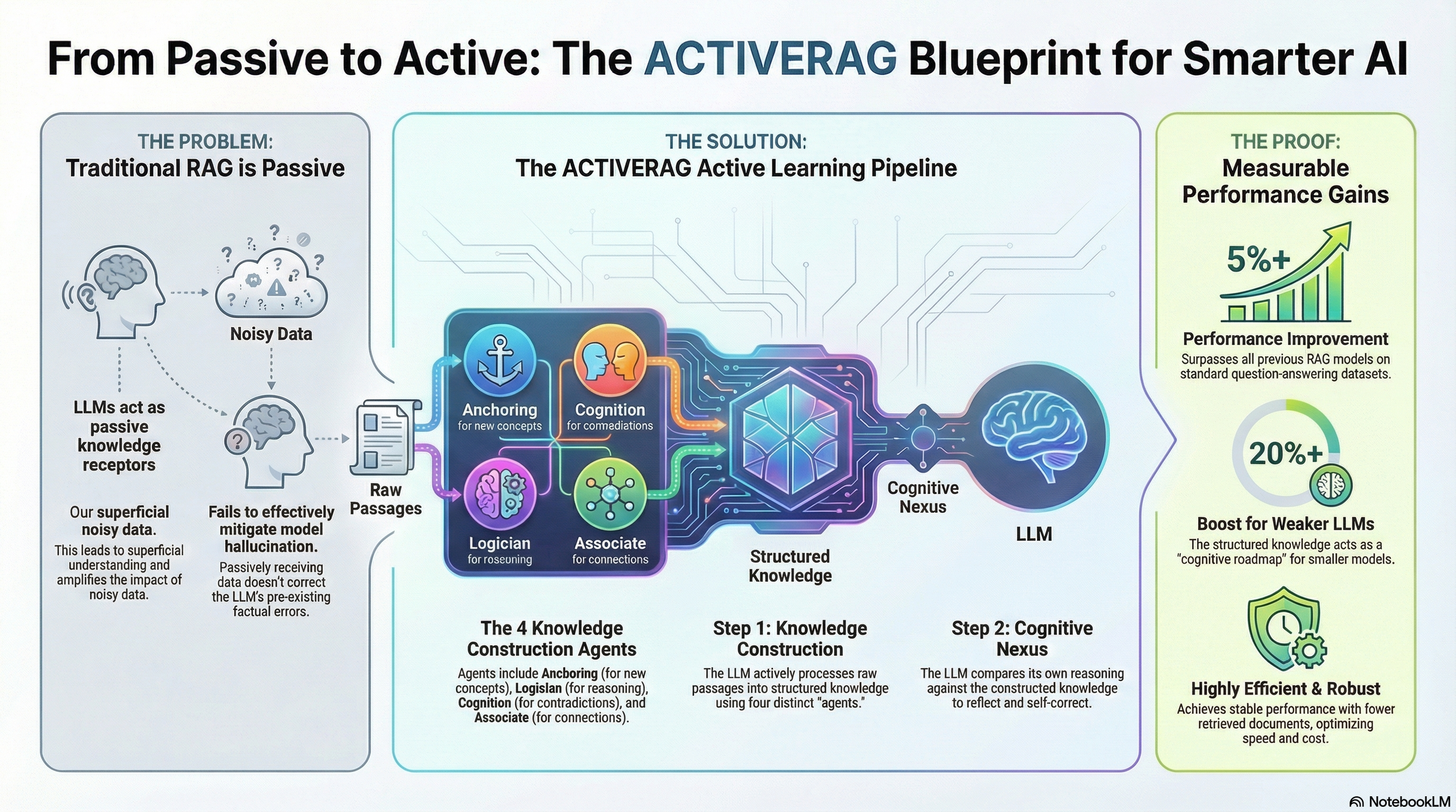
If you’ve built a standard RAG (Retrieval-Augmented Generation) pipeline, you know the dirty secret: it’s often just a glorified search engine attached to a smooth talker. We dump unstructured PDFs into a vector database, retrieve top-k chunks based on semantic similarity, and hope the LLM creates a coherent answer. In the recent ActiveRAG research, this is defined as "Passive RAG"—a system where the model acts as a passive receptor of data, often leading to superficial answers and confident hallucinations.
To explore how to move beyond this, we deployed the concepts from the ActiveRAG framework in a specific, high-complexity scenario: High-End Perfumery.
We wanted to see if we could move from passive data ingestion to proactive knowledge construction. Here is how we engineered a scenario that forces an AI to stop guessing and start thinking like a master perfumer.
1. The Methodology: Reviving Expert Elicitation
The ActiveRAG framework suggests looking back to 1990s Knowledge Engineering, specifically the practice of Expert Elicitation. The goal isn't to scrape the whole internet, but to interrogate specific domain experts to build a structured "knowledge base" of rules.
For our scenario, we identified a "Perfume Expert Six"—a group of historians, chemists, and critics including Victoria Belim-Frolova and Mark Behnke. From an engineering perspective, we treated these individuals as high-signal nodes. We simulated the extraction of their "tacit knowledge"—the unwritten rules they use to evaluate scent—to create a "cognitive roadmap" for the model.
2. The Implementation: The Epistemic Anchoring Document
The core of our implementation is the Epistemic Anchoring Document. Following the ActiveRAG guidelines, we structured this not as a context window filler, but as a "Source of Truth" with four distinct layers:
A. The Expert Network (Provenance Layer)
We established a roster of authority to help the model weigh input. By encoding the profiles of our "Expert Six," the system learns to value a critique from a professional evaluator (like Michael Edwards) over random user reviews.
B. The Rule-Base (The Logic Layer)
This was the most critical engineering step. We converted abstract expert intuition into technical heuristics.
- The Scenario: We applied Mark Behnke’s "Concentration Realism."
- The Logic: A standard LLM thinks "Higher Concentration = Stronger Smell."
- The Rule: IF a user requests "beast mode," THEN warn that increasing oil concentration can distort the scent (specifically citing Bergamot) rather than improving performance.
C. The Specialized Glossary (The Data Dictionary)
To prevent "vibe-based" token prediction, we implemented a rigorous glossary. We defined terms like Sillage (the trail of scent, distinct from longevity) and Attars (oil-based concentrates). This ensures the model uses precise nomenclature.
D. Hard Verification Markers (Unit Tests for Hallucination)
We injected quantitative facts to act as "Ambiguity Shields".
- The "Oud Disambiguation Rule": We mandated the system to detect the token "Oud" and immediately query: Do you mean the natural material or a synthetic accord?.
- The Reality Pin: We included hard data points, such as the fact that Chanel No. 5 contains exactly 1% aliphatic aldehydes. If the model generates a response deviating from this anchor, the framework’s Cognitive Nexus mechanism is designed to flag it for rectification.
3. The Future: From Storage to Reasoning
This scenario demonstrates that the Epistemic Anchor is just the foundation. According to the ActiveRAG methodology, this structured data allows for a Logician Agent to perform complex deduction.
By implementing these "Ambiguity Shields" and "Hard Verification Markers," we move the assistant from being a "passive recipient" to an active knowledge constructor.
The Takeaway
Our experiment with the Perfume scenario shows that data engineering isn't just about moving bytes; it's about structuring truth. By applying the ActiveRAG blueprint—replacing "Vector Soup" with Epistemic Anchoring—engineers can turn generic models into domain experts capable of justified, evidence-based reasoning.