ActitveRAG: Paper review and practical applications
ACTIVERAG: Revealing the Treasures of Knowledge via Active Learning
Overview Presentation
Overview Podcast
Leveraging ActiveRAG to build CustomGPT’s, assistant or agents:
INTRODUCTION
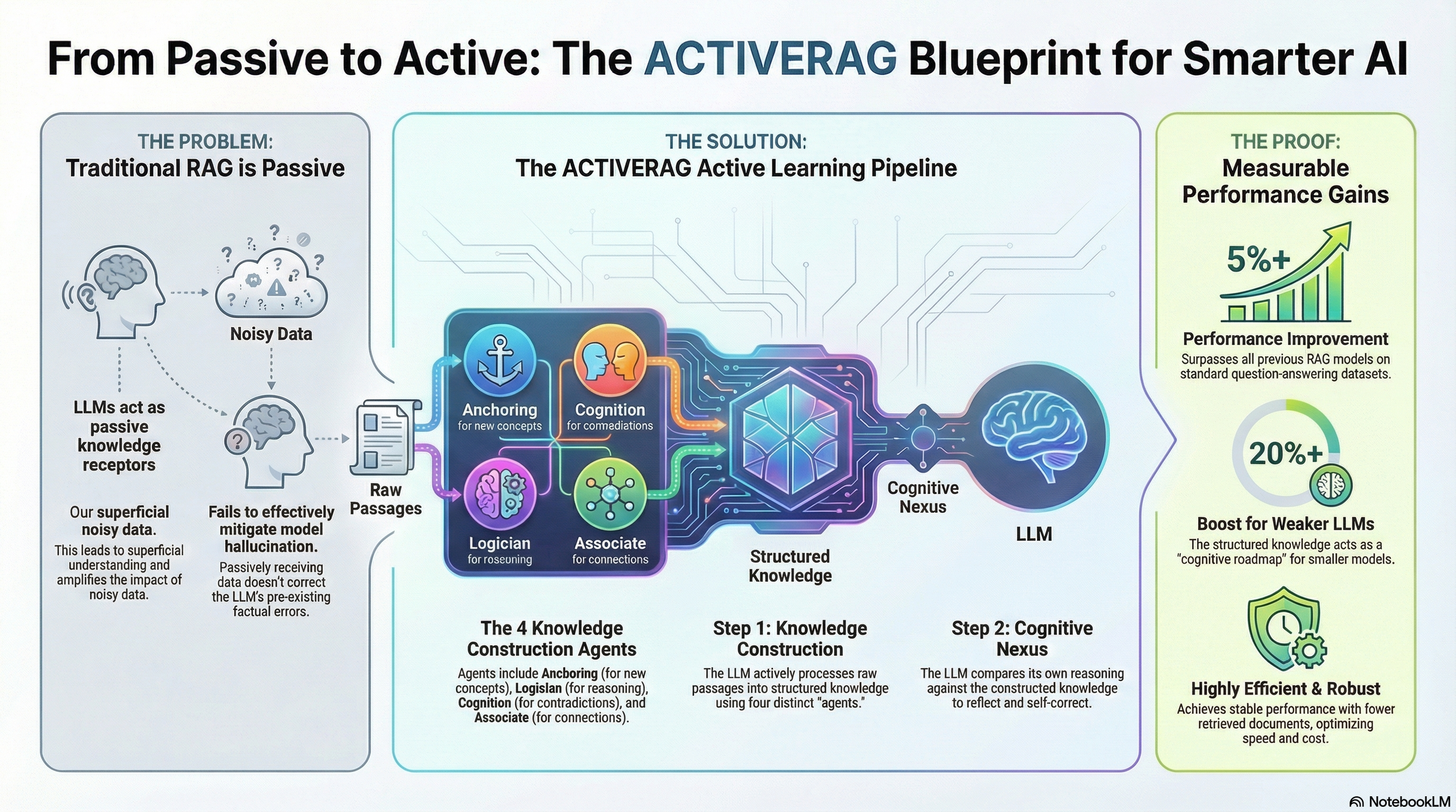
Large Language Models (LLMs), such as GPT-4 and LLaMA, have become central to resolving knowledge-intensive business tasks. However, the foundational method used to augment these models—Retrieval Augmented Generation (RAG)—is hitting a strategic ceiling. Traditional RAG models position LLMs as passive knowledge receptors, thereby restricting their capacity for deep learning and comprehension of external knowledge.
This passive approach often leads to superficial understanding, amplifies the impact of noisy retrieved knowledge, and fails to effectively mitigate the persistent hallucination problem.
We must transition our LLM architectures from passive data pipelines to systems that enable active knowledge acquisition. The ACTIVERAG framework, developed by researchers at Carnegie Mellon and universities across China, offers a validated blueprint for this transition, demonstrating over a 5% improvement on question-answering datasets compared to previous RAG models. Which is huge.
ACTIVERAG’s success stems from embracing the Constructivism theory, which posits that learners actively construct new understanding by associating external knowledge with previously acquired knowledge. This approach requires a structured, three-step pipeline: Retrieval, Knowledge Construction, and Cognitive Nexus. For senior Data and AI executives, deploying this innovation requires strategic orchestration, perfectly achieved through modern LLM deployment tools like CustomGPTs or Assistants, focusing on Static Context Augmentation and Dynamic RAG integration.
The 3-Step Deployment Playbook for ACTIVERAG via CustomGPT
The most effective RAG systems are not built on simple prompt engineering, but on engineered knowledge structures. This deployment strategy transforms raw knowledge into purpose-built cognitive assets that guide the LLM's reasoning.
Step 1: Create Specialized Foundation Documents (Knowledge Construction)
This initial phase executes the Knowledge Construction mechanism. Instead of relying on the LLM to process raw, noisy passages, we pre-process critical domain knowledge into three distinct, structured "foundation documents" that serve as Static Context Augmentation. These documents embody different cognitive learning views:
| Foundation Document | ActiveRAG Agent | Strategic Purpose & Source Reference |
|---|---|---|
| Epistemic Anchoring | Anchoring | Establishes foundational understanding by extracting content that is unfamiliar to the base model. This incorporates new concepts and relevant background to help the LLM better understand the query. |
| Logical Reasoning | Logician | Refines causal reasoning and logical inference abilities by leveraging structured information to draw logical conclusions. This extracts content that enhances the model’s logical capabilities, such as recognizing complex causal relationships. |
| Cognitive Alignment | Cognition | Mitigates factual errors and model illusion (hallucination). This addresses knowledge that may contradict the model’s pre-existing understanding, updating its knowledge using authoritative repository data. |
These documents, derived from your source RAG content using specific prompt templates, provide a "cognitive roadmap" that guides LLMs in learning from retrieved passages.
Step 2: Create a Cleanly Navigable Solution to the RAG (Dynamic Action)
While Step 1 handles the static, foundational knowledge, the system must retain the capability to pull current or niche information on demand. This is achieved by implementing the Retrieval stage as a defined Action within the CustomGPT architecture.
- Implement RAG as an Action: This API-driven Action connects to your enterprise RAG repository (e.g., using a retriever like T5-ANCE) to dynamically search and retrieve the top-k relevant raw passages (D = {d1,...,dn}) in response to the user's specific query.
- Strategic Rationale: ACTIVERAG proves to be highly efficient, showing nearly identical performance whether using the top 5 or top 10 retrieved passages. This demonstrates that the information extracted via the Knowledge Construction (Step 1) is often adequate to prompt the correct answer. The dynamic RAG Action is therefore reserved for instances where the structured static knowledge is insufficient, optimizing both speed and cost.
Step 3: Craft the Detailed Prompt for CustomGPT Instructions (Cognitive Nexus)
This final step implements the Cognitive Nexus mechanism, which fuses the LLM’s intrinsic thought process with the specialized knowledge constructed in Step 1. This fusion is enforced via detailed instructions, or the "meta-prompt," governing the CustomGPT’s behavior.
- Initial Chain-of-Thought (CoT) Generation: Instruct the CustomGPT to first generate an initial chain-of-thought for problem-solving based on the user's query. This represents the LLM's raw cognitive process.
- Mandate Reflection and Augmentation: This is the core Nexus instruction. Prompt the LLM to:
- Verify the initial reasoning process using the integrated Static Context Augmentation (the Anchoring, Logician, and Cognition documents).
- Enhance and rectify this raw CoT using the structured, specialized knowledge. This recalibration prevents the LLM from being misled by ambiguity (e.g., differentiating “The Woods” film from the producer "Robert Woods," which the Cognition agent handles).
- Conditional Dynamic Retrieval: Explicitly instruct the CustomGPT to utilize the Step 2 RAG Action only when reflection and static augmentation are insufficient.
This disciplined pipeline is crucial, as the ACTIVERAG framework demonstrated that actively incorporating knowledge construction into self-aware cognitive reasoning is superior to simply refining passages.
SUMMARY
Executing queries against large LLMs without any context can result in lengthy, rambling responses and potential hallucinations as this research proved. Providing improved context through the ACTIVERAG approach consistently achieves significant improvements over passive RAG baselines, proving its effectiveness in uncovering valuable knowledge from retrieved passages.
A more simplified implementation of ACTIVERAG leveraging CustomGPTs or assistants can help optimize domain specific solutions as long as the knowledge documents and deep RAG actions are well engineered.
Full production solutions leveraging ACTIVERAG following on many different models, even improving the performance of less expensive self hosted models. But when deploying via an agentic structure ACTIVERAG necessitates calling the ChatGPT API (or other model API’s) thrice (once for initial CoT, once for knowledge construction, and once for the cognitive nexus). This multi-step process can introduce additional time latency and API calling costs compared to simple RAG. However, this trade-off is justified by the proven superior accuracy, better mitigation of hallucination, and the ability to effectively guide LLMs to a deeper understanding.
What is compelling is that ACTIVERAG can be leveraged to improve deep domain responses, reduce hallucinations and deliver higher quality, predictable results without the full overhead of fine tuning custom models.
As this approach gains traction, the high quality data engineering of the source datasets essentially becomes cognitive engineering and for that you need the kind of data design experts on AIDC.